

When it comes to desirable Boston addresses, it’s hard to beat the Boston Harbor area. Two prestige neighborhoods sit next to each other on the Harbor - the North End and the Waterfront District.
They’re adjacent, minutes from downtown, and enviably close to the water … but in character, they could hardly be more different. It’s a matter of taste. Are you a “North End” personality, or a “Waterfront” personality? Let’s examine both neighborhoods so you can figure out which one you are … and which one you should target for your house-hunt.
.jpg)
North End
There’s historic, and then there’s the North End - Boston’s oldest residential neighborhood, dating back to 1630. Paul Revere lived here; the 1680-built Paul Revere House is still standing at 19 North Square and built on the former site of influential colonial minister Increase Mather’s former house. The 18th-Century Old North Church, Boston’s oldest church, is where Revere lit his “one if by land, two if by sea” beacon to warn Minutemen of the approaching British Navy.
So what’s it like to live amid all that history? It’s like living in an old European city center - narrow brick streets that encourage walkability, a short walk from the Financial District, State Street, and Long Wharf. Cafes, bakeries, and markets along main thoroughfares like North Square, Hanover Street, and Salem Street.
The North End has one of the most vibrant neighborhood cultures in Boston proper, suffused by its Italian-American heritage. It’s the restaurant capital of Boston, with outdoor dining a mainstay.
This is Boston’s “Little Italy.” It’s not as polished as the Waterfront District, but you can’t beat the North End for its lively energy and rich neighborhood traditions, which peak during Catholic Feast season (Saint Anthony's Feast, Feast of Saint Agrippina, etc.).
Homes here are mostly historic Brownstones and condo conversions, often smaller but full of character. Most don’t have garages, so you will need to obtain a resident street parking permit … or join the ranks of Bostonites who abandoned car ownership.
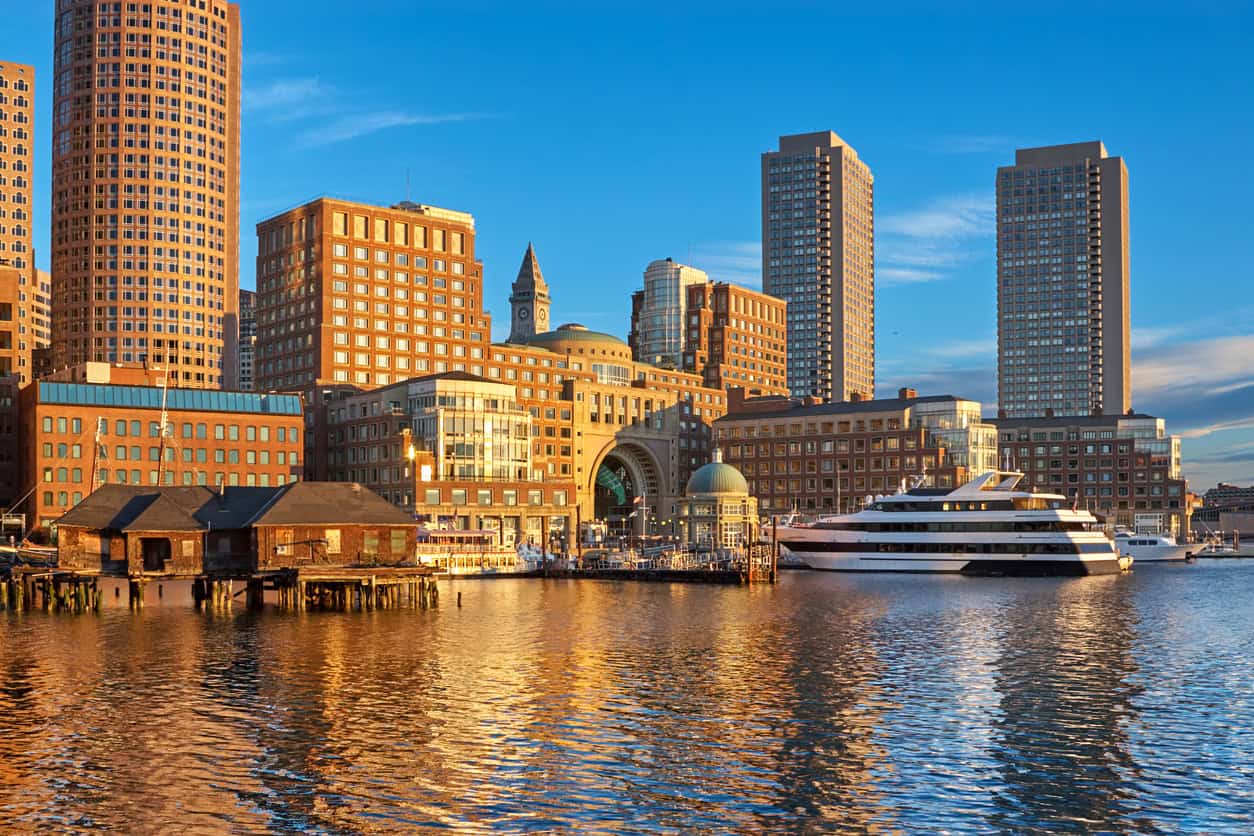
Waterfront District
Whereas the North End emphasizes on history, the Waterfront District screams contemporary luxury. More residential and less tourist-oriented, it’s an oasis of waterfront promenades, luxury hotels, upscale restaurants, and elegant modern condos.
Anchored by the Boston Harborwalk, this is the neighborhood where you will find Long Wharf, Rowes Wharf, and Central Wharf. You’re still an easy walk from downtown Boston, as well as the Financial and Seaport Districts, but there’s less nightlife and street-level energy here than in the North End.
Nevertheless, there’s much to love in the Waterfront District. Standouts include Faneuil Hall Marketplace, the New England Aquarium, and Christopher Columbus Waterfront Park.
The elite, modern polish makes the Waterfront District a favorite for empty-nesters, executives at nearby Fidelity or Deloitte, and second-home buyers. It’s also one of the best neighborhoods for boat owners, as we discuss in our blog on looking at neighborhoods with on-site boat docking.
Bottom Line
So where should you live, the North End or the Waterfront District? Lean toward the North End if you want the quintessential Boston lifestyle - lively streets, historic scenery, palpable culture and sense of community. If you want a more sleek, peaceful, and modern lifestyle, err on the side of the Waterfront District.
Whichever choice you make, the best of Boston is only a few steps away.
Frequently Asked Questions
Q: What kinds of homes are there in the North End and the Waterfront District?
A: The North End is characterized by historic brick buildings - Brownstones and boutique condo conversions. Homes tend to be smaller, but have lots of historic character … along with some of the quirks of older buildings.
In the Waterfront District you will find more luxury concierge condominium communities, many with Harbor views, modern layouts, and more square footage.
Q: What are home prices like in the North End and the Waterfront District?
A: As of this writing, North End homes currently sit at a median sold price of $1.15M. Waterfront District homes, larger and newer but less historic, push the margin a little at $1.235M. Note that prices constantly change; contact us for the latest pricing data.
Q: What is the commute like from the North End and the Waterfront District?
A: Both communities are an easy walk to Downtown Boston, the Financial District, Long Wharf, and employers like Fidelity, Deloitte, and Massachusetts General Hospital.
The North End features easy access to I-93 and offers easy access to the MBTA at Haymarket, North Station, Aquarium, and Government Center.
The Waterfront District features Blue Line access at Aquarium Station. It also adds ferries into the mix, with ferry and water taxi service available for destinations across the Harbor. It’s also conveniently close to Logan Airport.
Q: Which neighborhood is better for waterfront living?
A: Both the North End and the Waterfront District provide easy Harbor access, but in the North End it’s more about waterfront parks and marinas. Residential living is more neighborhood-focused, while the density and lower-rise construction restricts views of the water.
The Waterfront District is more conducive to what people think of as “waterfront living,” with Harbor views from many condos, many buildings positioned right on the water and some newer buildings featuring boat slips or private marinas.

Social Media